
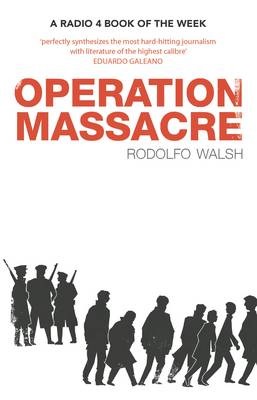
Author: Rodolfo Walsh
Publisher: Old Street Publishing
First published: 1957
Setting: Argentina
Read in February 2014
My Rating ★★ 2.3
“Historically monumental – disappointing !”
A true story of the brutality of the Argentinian inter Peron years with a cover-up of a botched execution of a dozen innocent victims. There were 5 deaths and at least 7 survivors although some had been left for dead.
This is considered the first book in the genre of investigative journalism. Written 50+ years ago in a country where kidnapping and killings were commonplace and tracking down survivors who did not want to be found, can only be considered herculean. However, while there is an intriguing plot it seemed to me that it was too personally and politically motivated. I also found it difficult keeping track of the cast, who was murdered, who survived, who was in the police, government or judiciary.
Book Review
Late on June 9th 1956 in Buenos Aires, Argentina, a dozen men were arrested and then executed a few hours later. Martial Law was not introduced until the 10th and so it was illegal to execute the men without trial, murder in fact. But there were witnesses to the execution, several survivors, 5 men lost their lives leaving wives and 16 children behind.
When Rudolfo, a journalist, hears several weeks later that there was a survivor to this relatively unreported incident he sees an opportunity for a scoop and starts to investigate. In a country run by dictatorships and a military junta, with kidnapping, disappearances and killings commonplace, pursuing a possible police cover-up is difficult and dangerous for all involved.
We therefore have a strong plot, one based on an actual event. Where for me this book struggles to engage is that it becomes too obvious that Rudolfo’s mission is to bring down the Chief of Police, a colonel, who was responsible for ordering the executions, it feels personal, it feels political. The other negative is that it is difficult trying to keep up with the people involved in the drama, who was murdered, who survived, who was in the police, government or judiciary. There is a useful character list at the back, but a diagram at the front would have been an advantage. On 24th March 1977 Rodolfo sent an open letter to the Military Junta and the following day he was kidnapped not to be seen again, presumed murdered.
Published in 1957 this book is recognised as the first book in the genre of investigative journalism. There is no doubt that Rodolfo undertook a monumental task tracking down survivors who did not want to be found, especially as nobody really knew how many people had been arrested and taken to the garbage dump to be executed. His perseverance and bravery in following through on the publishing of this book is to be highly commended. My expectation from the hype on the cover was unfortunately not delivered.
 The Diary of a Digital Nobody